Introduction
Strategic planning often suffers from a fatal flaw: incrementalism. When faced with big challenges, we tend to rely on past successes to predict future solutions. We brainstorm “outside the box,” but rarely step far enough away from it to see the real opportunities. To break this cycle of conventional thinking, Adam Morgan and Mark Barden introduced a mode if inquiry in their book “A Beautiful Constraint”.
We have adapted this concept, applying strategic foresight tools to turn it into a rigorous framework for navigating future scenarios. We call it the Compelling Question™.
Here is how to define it, dissect it, and use it to map futures trajectories.
The Definition
At its core, a Compelling Question™ is a strategic tool designed to fracture conventional thinking and reveal latent opportunities within complex problems. It is not merely an inquiry; it is a forcing function for innovation.
It works by confronting the asker with a paradox, fusing together two seemingly incompatible elements:
- A Bold Ambition (a high-stakes goal defined by the “what” and “when”).
- Significant Constraints (the severe limitations that define the playing field).
This structure moves the conversation away from incremental improvements and toward lateral, systemic problem-solving. It demands that we suspend disbelief regarding the goal while simultaneously acknowledging the harsh reality of the limitations.
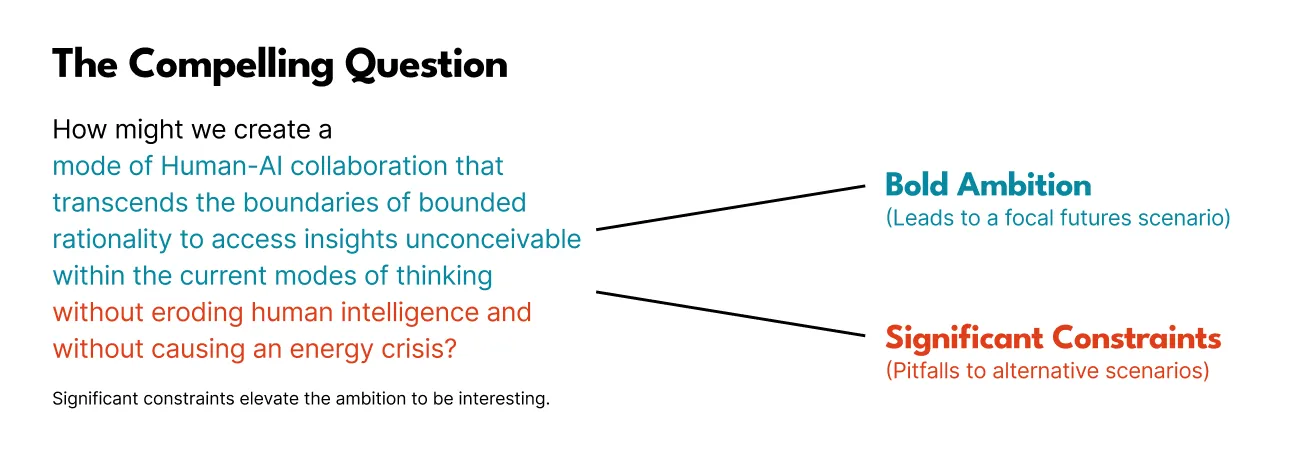
Figure 1: The structure of a Compelling Question combines a bold ambition (“What if, by When?”) with significant constraints.
The Foresight Twist
While standard brainstorming uses ambition as a target, our approach uses foresight to treat the ambition as a reality. By applying a futures lens, the two core components take on functional roles in mapping strategy:
1. The Ambition acts as “Design Fiction”
We don’t ask if the ambition is possible. We treat it as a “supposed future”, a scenario that has already occurred. This allows the team to inhabit that desired state mentally and work backward, visualizing a world where the problem is already solved.
2. The Constraints act as “Scenario Off-Ramps”
Almost like a pre-mortem analysis, the significant constraints are used as critical intelligence. They represent the exact junctions where the trajectory toward the supposed future is most likely to fail. If a specific constraint is ignored, the strategy “goes off the rails” and falls into alternative scenarios.
Dissecting the Question
Once we formulated the Compelling Question, we analyze the tension between ambition and constraint using two distinct modes of thinking derived from Morgan and Barden’s methodology.
Phase 1: “Can’t Because” (Identifying Risks)
This is the default reaction. When facing a severe constraint, it is natural to list the barriers that make the ambition impossible.
The Mindset: Listing obstacles.
These aren’t just complaints; they are early warning signals for Scenario Off-Ramps. Every “Can’t Because” statement identifies a specific point where the strategy will collapse if unaddressed.
Phase 2: “Can If” (Navigation Logic)
This is the pivot. We must force the conversation to switch from listing barriers to finding conditions for success. We replace “We can’t achieve X because of Y” with “We can achieve X if we change Z.”
The Mindset: Finding requisite conditions.
This is the Navigation Logic. It maps the exact innovations, partnerships, or policy shifts required to steer around the off-ramp and keep the trajectory on track to the Design Fiction.
Seeing It In Practice
Let’s look at an example of how this framework moves from a question to a strategic map.
How might we achieve a zero-carbon logistics network by 2035 (Ambition) while relying exclusively on existing legacy infrastructure grids (Constraint)?
If we attack this with normal brainstorming, the constraint will kill the ambition immediately.
Using the framework, we dissect it:
- Design Fiction (The Ambition): It is 2035. The network is zero-carbon. We are working backward from this reality.
- The Off-Ramp (The “Can’t Because”): We can’t reach zero-carbon because the legacy grid cannot support the voltage required for rapid fleet charging at our central hubs. If we don’t solve this, the scenario fails and the fleet stays grounded.
- The Navigation Logic (The “Can If”): We can reach zero-carbon using the legacy grid if we stop relying on central hubs and instead decentralize power generation at individual depots using local solar and battery storage.
The Compelling Question framework does not promise easy answers. Instead, it provides a rigorous way to confront the tension between what you want and what is stopping you. By turning ambitions into design fictions and constraints into navigable off-ramps, you stop just talking about the future and start mapping the concrete steps to get there.
Framework Applications
The Compelling Question serves as the second enrichment layer for the Context band of the CITAble Businesses framework. Where Problem-First Research establishes what problems exist, why they matter, and who is affected, the Compelling Question transforms that understanding into structured provocations that reveal what must change.
In a CITAble organisation, the Context layer moves through a recommended progression:
- Three Ws (core): What problems exist, why they matter, who cares
- Problem-First Research: Temporal analysis, failure archaeology, evidence-backed depth
- Compelling Questions: Bold Ambition + Constraints, producing Can’t Because / Can If analysis
- Innovation Challenges: Evaluation criteria, success metrics, public framing
The Can’t Because / Can If analysis is the specific contribution that bridges pure problem understanding into actionable framing. Each “Can’t Because” identifies a barrier grounded in the problem research. Each “Can If” identifies a condition that must become true. These conditions serve two downstream functions within CITAble:
- They inform Innovation Challenge evaluation criteria (conditions become measurable success indicators)
- They inform the Indicators-Strategy band (conditions become the foundation for OKRs and strategic requirements)
The Compelling Question remains in the Context layer because it does not prescribe solutions. It identifies required conditions for success without specifying how those conditions will be created. That prescription belongs to Strategy. This separation preserves the problem-first integrity of Context while providing the bridge material that makes strategy justifiable rather than arbitrary.